


About Canada
Canada is a country in North America made up of 10 provinces and 3 territories. Located in the northern part of the continent, it stretches from the Atlantic to the Pacific and northward into the Arctic Ocean. At 9.98 million square kilometres in total, Canada is the world’s second-largest country by total area and the fourth-largest by land area. Its border with the United States is the world’s longest land border shared by two countries.
Canada has the eighth-highest per capita income in the world and ranks eleventh on the Human Development Index.
Education in Canada is entirely the responsibility of the provinces and territories (the equivalent of our states) – there is no federal (central) education system. In keeping with the national commitment to education, public education is free in every province up to and including secondary school (Class 12).
Popular universities
- University of Toronto
- McGill University
- University of British Columbia
- University of Alberta
- McMaster University
- University of Montreal
- University of Waterloo
- University of Western Ontario
- University of Calgary
- Queen’s University
- Simon Fraser University
- Dalhousie University
- University of Ottawa
Provinces and territories
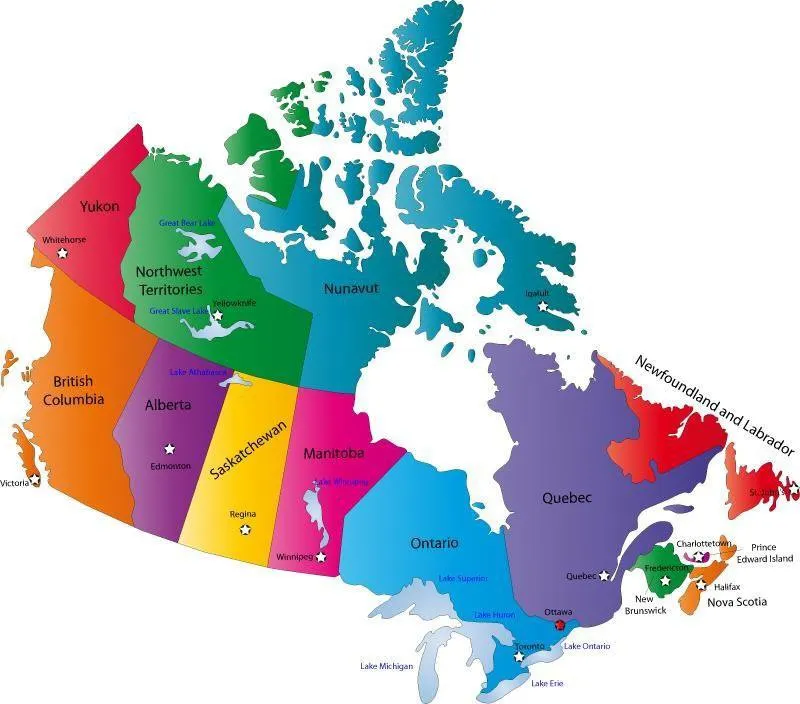
Provinces
- Ontario
- Quebec
- Nova Scotia
- New Brunswick
- Manitoba
- British Columbia
- Prince Edward Island
- Saskatchewan
- Alberta
- Newfoundland and Labrador
Territories
- Northwest Territories
- Yukon
- Nunavut
Education system
Canada has one of the best and most respected education systems in the world, and every year thousands of students from other countries come here to pursue their educational goals. With new ways to gain valuable Canadian work experience during and after your studies, the advantages of studying in Canada are great. There are also permanent immigration options for international students who graduate from post-secondary programmes in Canada.
Canada’s education system is organised in levels: elementary (kindergarten to Grade 8), secondary (Grade 9 to 11 or 12) and then post-secondary options, from college to university.
As a global leader in innovation, technology, research and development, Canada’s post-secondary system is at the centre of the new knowledge economy. You can choose to study at a college, a university or both – developing key skills, working with industry and contributing new ideas to the academic community.
Qualifications you can study for
- Bachelor’s degree
- Postgraduate diplomas / certificates
- Master’s degree
- Doctorate (PhD)
Entry requirements
All students applying to Canadian institutions must be fluent in English, and international students need to reach the required level of English language competence.
Undergraduate studies
- First class in HSC (Class 12)
- IELTS 6.0 / 6.5
- TOEFL 80 and above
Master’s studies
- First class in your bachelor’s degree (3-year degree in India)
- Postgraduate certificate or diploma
- IELTS 6.0 / 6.5 or TOEFL 90 and above
English language scores
| Test | Undergraduate | Postgraduate |
|---|---|---|
| IELTS | 6.0 / 6.5 | 6.5 / 7.0 |
| TOEFL | 80 and above | 90 and above |
Scholarships
Scholarships in Canada are quite competitive because there are far fewer of them than in countries such as the USA, the UK or Australia. Eligibility is judged on outstanding academic grades and exceptional English proficiency scores. Most universities award scholarships automatically – with no separate application – to students who meet their eligibility benchmarks, but at some institutions you need to apply specifically. Scholarships are mostly offered at entry level, though for some you must keep proving your academic excellence in the following years of your course as well.
Popular scholarships
- PEO International Peace Scholarships for Women
- Ontario Graduate Scholarships (for a master’s programme)
- Dalhousie University Scholarships
- University of Saskatchewan International Student Awards
- York University International Student Scholarships
- University of Waterloo – Entrance Scholarships
- Lakehead University – Undergraduate Entrance Scholarship
- Brock University – Undergraduate Entrance Scholarship
- Trent International Global Citizen Scholarships and Awards
Visa requirements
Depending on your country of origin and the type and length of your studies, you may need:
- a temporary resident visa
- a study permit
- a CAQ (Quebec Acceptance Certificate), if you are going to study in Quebec
Do you need a study permit?
The documents you need depend on your country of origin, your programme and how long you will study:
- Programmes of up to six months: no study permit is required.
- Programmes longer than six months: a study permit is required.
If your programme is six months or shorter but you think you may continue into another programme afterwards, apply for a study permit before you come to Canada. Without a valid study permit, you would have to leave Canada to apply for one before you could continue your studies.
 USA
USA UK
UK Ireland
 Australia
 New Zealand