



About Australia
Australia’s neighbours are Indonesia, East Timor and Papua New Guinea to the north, the Solomon Islands and Vanuatu to the north-east, and New Zealand to the south-east. It is one of the wealthiest countries in the world, with the world’s 12th-largest economy.
Australia is a member of the United Nations, the G20, the Commonwealth of Nations, ANZUS, the Organisation for Economic Co-operation and Development (OECD), the World Trade Organization, Asia-Pacific Economic Cooperation and the Pacific Islands Forum.
Why study in Australia
As well as world-class universities and strong career prospects, applying to Australia is refreshingly straightforward:
- No application fee at a majority of universities
- Flexible deadlines – universities are ready to accept applications and financial documents closer to the course start date
- Lower entry requirements at universities with relatively high international rankings
- No visa interviews
- Quick visa outcomes
- GST is paid over and above commissions For review: this line was on the old public page but reads like an internal note about agent commissions — keep or remove?
Popular universities
| University | Location |
|---|---|
| The University of New South Wales | Sydney |
| The University of Queensland | Brisbane |
| Monash University | Melbourne |
| The University of Western Australia | Perth |
| The University of Adelaide | Adelaide |
| University of Technology Sydney | Sydney |
| University of Wollongong | Wollongong |
| RMIT University | Melbourne |
| The University of Newcastle | Newcastle |
| Curtin University | Perth |
| Macquarie University | Sydney |
| Queensland University of Technology | Brisbane |
| Deakin University | Melbourne and Geelong |
| University of Tasmania | Hobart and Launceston |
States and popular cities
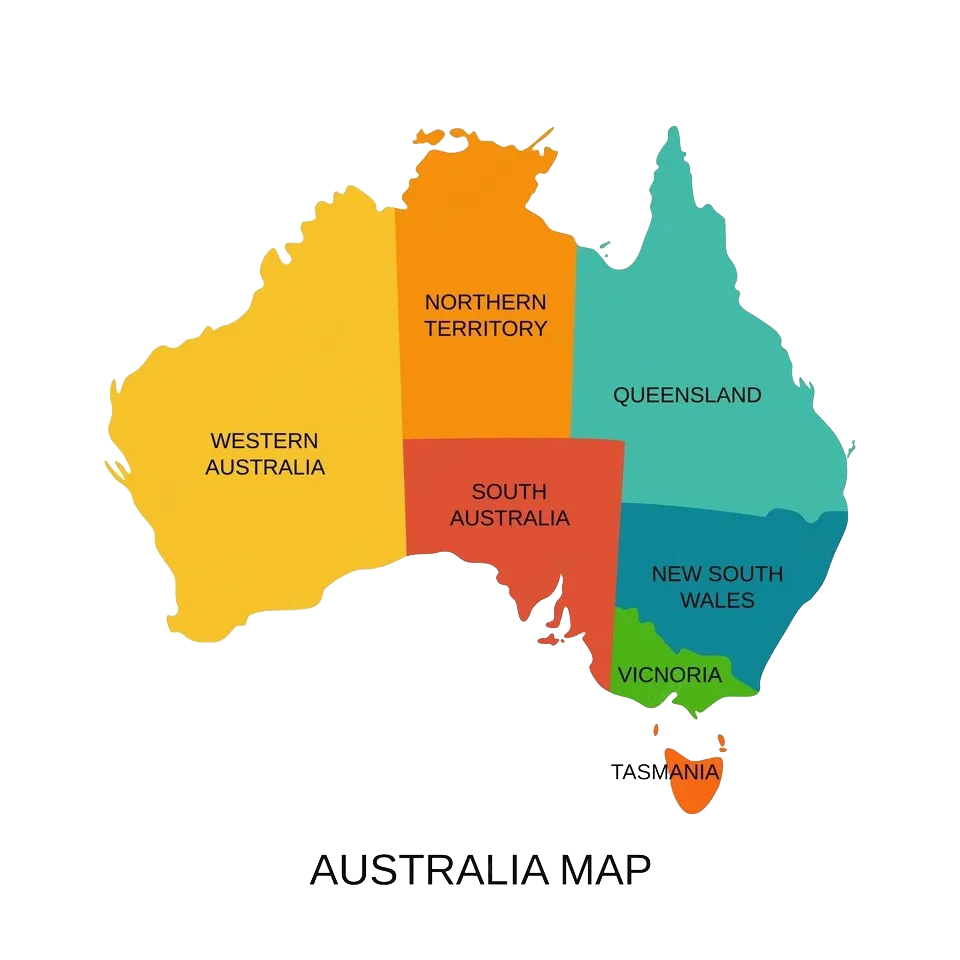
States and territories
- Northern Territory
- Queensland
- Western Australia
- South Australia
- New South Wales
- Victoria
- Tasmania
Popular cities
- Sydney
- Brisbane
- Melbourne
- Adelaide
- Perth
Education system
Australia offers international students a diverse range of study options, with more than 1,200 institutions and over 22,000 courses to choose from. The higher education system is made up of independent, self-governing public and private universities and higher education institutions that award higher education qualifications.
There are 38 public universities and 3 private universities in Australia.
When to apply
Start your applications ideally 7–8 months before your intake. Universities generally take around 4–6 weeks to process an application.
Entry requirements
Undergraduate
- A good academic record in your High School Certificate, or 12 years of schooling
- Some courses, such as Computing and Engineering, require Mathematics and/or Science as prerequisites
- IELTS 6.0
Postgraduate – Master’s
- A good academic record in a bachelor’s degree from a recognised university
- Any work experience in your field will help
- For MBA programmes at some universities, you need work experience along with your bachelor’s degree
- IELTS 6.0
Tuition and living costs
Tuition fees
The cost of studying in Australia depends on the institution and the level of study you choose. As an international student, you pay your tuition fees before you begin your studies. Costs vary for each type of qualification:
- Undergraduate bachelor’s degree
- Postgraduate master’s degree
- Doctoral degree
- English language studies – around $300 per week, depending on course length
Living costs
Australia is a friendly, affordable country with one of the highest standards of living in the world. As a general guide, the average international student spends on accommodation, food, clothing, entertainment, transport, international and domestic travel, telephone and incidental costs:
| Period | Average living cost |
|---|---|
| Per week | about AU $390 |
| Per month | about AU $1,550 |
| Per year | about AU $18,610 |
On top of this, budget for your return trip home and international phone calls.
Working while you study
International students may work up to 40 hours a fortnight during each session. However, competition for part-time work is significant, so you should not expect earnings from a part-time job to cover your tuition fees or living expenses.
Scholarships
Many scholarships, grants and bursaries can support you financially while you study in Australia. They are offered by the Australian Government, education institutions and a number of other public and private organisations. Many are open to students of all nationalities, but every scholarship’s conditions are set by the institution or organisation offering it, and you apply directly to the scholarship provider.
Universities with higher scholarships
| University | Scholarship |
|---|---|
| The University of Adelaide | 15%–30% |
| University of Wollongong | 20%–30% |
| The University of Newcastle | – |
| Macquarie University, Sydney | – |
| RMIT University | – |
| Deakin University | – |
| Griffith University | – |
| La Trobe University | – |
| Flinders University | – |
| Western Sydney University | – |
| Swinburne University of Technology | – |
Visa requirements
The student visa you need depends on your chosen course of study. The key requirements you will typically need to meet are:
- An electronic Confirmation of Enrolment (eCoE) certificate
- Meeting the Genuine Temporary Entrant requirement
- Sufficient funds for airfares, course fees and living costs
- English language proficiency
- Meeting health and character requirements
- Acceptable Overseas Student Health Cover (OSHC)
 USA
USA UK
UK Ireland
 Canada
 New Zealand